

Stocks Fall on Iran Conflict and Rising Oil Prices; Bonds Also Fall
Good morning,
The Dow (-3.0%), NASDAQ (-1.2%), S&P 500 (-2.0%) and Int’l (-6.7%) all fell sharply for the week. Similarly, taxable bonds fell 1.0% and tax-free municipal bonds slid 0.8%. The 10-year Treasury yield rose 0.19% to finish the week at 4.15%.
Leading the headlines is the conflict with Iran that is now in its second week. Iran is one of the world’s largest producers of oil, and a significant portion of the world’s oil supply must pass through the Strait of Hormuz, and Iran is threatening any ships that want to pass through. Thus, the price of oil has rocketed in the last 10 days, rising above $100 per barrel overnight, which is almost 70% higher than it was prior to the conflict. See the chart below.
WTI Crude Oil ($ / barrel)
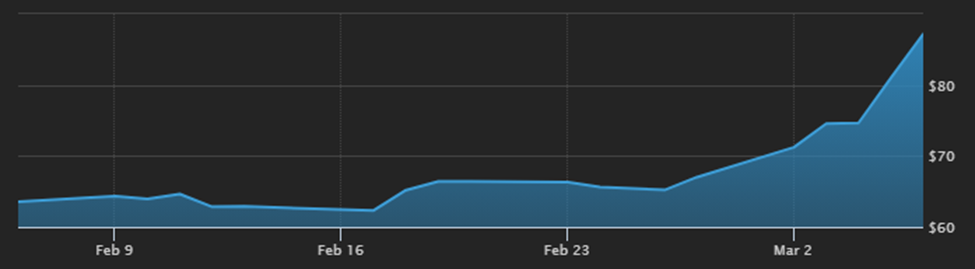
Source: WSJ.com
The war in the Middle East masked economic news reported last week. The Institute of Supply Managers (ISM) Manufacturing and Services sectors reports came in fairly well, but showed evidence of sharp price increase in manufacturing costs, reaching its highest level since June 2022. Then the worst news of all was the February jobs report on Friday, which showed a decrease of 92,000 jobs, compared to an expected gain of 50,000 jobs. This puts the Fed in a bit of a pickle because job losses suggest a rate cut could be in order, but the rising oil prices and manufacturing prices put pressure on inflation, which would suggest raising interest rates to combat the rise in prices.
The Middle East conflict is creating geopolitical tensions worldwide, particularly with Iran shooting missiles at nearly every other country in the region. More importantly, the flow of oil out of the Middle East is creating a supply chain problem and a sharp rise in oil prices. This has a cascading effect, such as inflation, and threats of energy shortages in many countries. While we believe the conflict may be short-lived, the question is how long will the higher oil prices continue, and what will be the lasting effects, if any. It’s a little too early to tell, but given the midterm elections only 8 months away, you can figure that US politicians will want this to be over very quickly.
Have a great day and terrific week!

Source: Yahoo Finance
Content in this material is for general information only and not intended to provide specific advice or recommendations for any individual. All performance referenced is historical and is no guarantee of future results. All indices are unmanaged and may not be invested into directly.
The economic forecasts set forth in this material may not develop as predicted and there can be no guarantee that strategies promoted will be successful. All investing involves risk including loss of principal. No strategy assures success or protects against loss. There is no guarantee that a diversified portfolio will enhance overall returns or outperform a non-diversified portfolio. Diversification does not protect against market risk.
The Standard & Poor’s 500 Index (S&P500) is a capitalization-weighted index of 500 stocks designed to measure performance of the broad domestic economy through changes in the aggregate market value of 500 stocks representing all major industries. The NASDAQ Composite Index measures all NASDAQ domestic and non-U.S. based common stocks listed on The NASDAQ Stock Market. The market value, the last sale price multiplied by total shares outstanding, is calculated throughout the trading day, and is related to the total value of the Index. Government bonds and Treasury bills are guaranteed by the US government as to the timely payment of principal and interest and, if held to maturity, offer a fixed rate of return and fixed principal value.

