

Stock Markets Continue to Slide on Middle East Conflict; Bonds Also Fall
Good morning,
The Dow (-2.0%), NASDAQ (-1.3%), S&P 500 (-1.6%), and EAFE [int’l] (-2.0%) each fell for the week and posted their lowest closing values of 2026. Similarly, taxable bonds fell 0.9% and tax-free municipal bonds fell 0.7%. The 10-year Treasury gained 0.13% to finish the week at 4.28%.
The Middle East conflict is the source of market volatility for a variety of reasons, but mainly because of the restricted flow of oil through the Strait of Hormuz, which represents 20% of the world’s oil consumption. The trickle down effect is pretty significant, as it represents an increase in the price of gasoline and fuel needed for normal transportation, as well as the transportation of goods around the world. Thus, this will also likely impact inflation, which could then change the Fed’s view toward cutting, or even possibly raising interest rates. Needless to say, this has had an adverse effect on stocks, but also with bonds due to the concerning impact on inflation.
In economic news, two key inflation gauges were reported last week – Consumer Price Index (CPI) and the Fed-favored Personal Consumption Expenditures (PCE). Both CPI and PCE were reported as relatively tame and in line with economist expectations. However, those values were from February and did not reflect the Middle East conflict which began at the end of February. Thus, next month’s inflation readings will certainly take on greater significance.
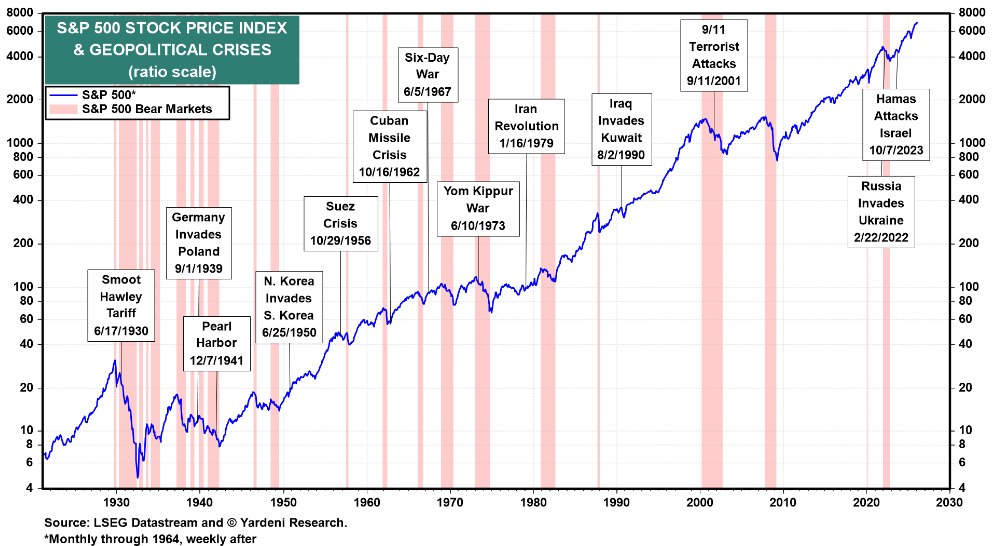
Big picture – this conflict and the restriction of global oil supply is considered by economists and investors as being temporary. This is evidenced by the current price of oil near $100 per barrel, but less than that when evaluating future prices in only a few months. That is certainly a relief to see, and hopefully this spike in oil prices remains short-lived. More importantly, how will this impact the stock markets? While I don’t have a crystal ball (I actually do, but it didn’t come with instructions), history has shown that long term impacts from geopolitical events is rare. See the chart below provided by Cornerstone Portfolio Research, our CFA consulting team.
Chart of the Week—Volatility due to geopolitical events can be unnerving, but history shows long term stock impacts from such events are rare.
Have a great day and terrific week, and Happy St. Patrick’s Day to all our Irish friends!

Source: Yahoo Finance
Content in this material is for general information only and not intended to provide specific advice or recommendations for any individual. All performance referenced is historical and is no guarantee of future results. All indices are unmanaged and may not be invested into directly.
The economic forecasts set forth in this material may not develop as predicted and there can be no guarantee that strategies promoted will be successful.
The Standard & Poor’s 500 Index (S&P500) is a capitalization-weighted index of 500 stocks designed to measure performance of the broad domestic economy through changes in the aggregate market value of 500 stocks representing all major industries. The NASDAQ Composite Index measures all NASDAQ domestic and non-U.S. based common stocks listed on The NASDAQ Stock Market. The market value, the last sale price multiplied by total shares outstanding, is calculated throughout the trading day, and is related to the total value of the Index. Government bonds and Treasury bills are guaranteed by the US government as to the timely payment of principal and interest and, if held to maturity, offer a fixed rate of return and fixed principal value.

